Whether it be a commercial endeavor, military project, or space expedition, all aircraft components must be up to the highest standard, from the minute interior detail to the aircraft’s engine. This high level of precision required within the aerospace sector has made computer numerical control (CNC) machining an integral part of the aerospace manufacturing process as CNC machining can attain tolerance levels up to 0.002 mm. In that regard, CNC machines, along with the sophisticated design and workflow software and state-of-the-art inspection processes, produce a wide range of end-use parts and high-quality tooling components for aerospace manufacturers today.
As the manufacturers are increasingly seeking out ways to enhance productivity and flexibility while cutting costs, cutting-edge technologies are making CNC machining more accessible, reliable, and agile. For instance, the 5-axis machines, which represent the pinnacle of milling ability, have become financially accessible to even small manufacturers today. Meanwhile, CNC machines are being developed to handle up to six to twelve axes at once. While it is ideal for high accuracy production of huge machine parts in the aerospace industry, 6-axis manufacturing equipment is also known to reduce the production time by 75 percent.
At the same time, CNC programming has become fully automated with the advent of computer integrated manufacturing systems (CIMS) technology. The principal difference between CIMS and computer-aided design (CAD) / computer-aided manufacturing (CAM) systems is that the process parameters required for programming are obtained directly from the computer-aided process planning (CAPP) database within the system. It doesn’t require any human intervention.
There is a surge in demand for machines-as-a-platform as well. As it facilitates the testing of machine calibration and product design in a digital setting, the chances of collision and machine damage are alleviated while carrying out intricate designs. The domain is also witnessing a widespread adoption of collaborative robots (cobots). Unlike industrial robots, cobots are programmed to work intuitively alongside human workers, and they can even be taught their intended operations with manual movements.
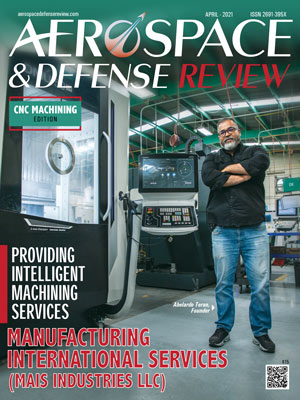
At this juncture, there is a variety of CNC machining service companies available in the market that cater to the different needs of aerospace and defense manufacturers. To help them choose the company that best fits their requirement, Aerospace and Defense Review has compiled a list of the top 10 CNC machining service companies. The enlisted companies are the frontrunners in the market that provide a wide span of features. Besides, the magazine also comprises insights from thought leaders in the sector on the industry trends, best practices, recent innovations, and their advice for aspiring CIOs.
We present to you Aerospace and Defense Review’s, “Top 10 CNC Machining Service Companies – 2021.”